
T: 0086 13510078491
Tianraobu Village, Hengli Town, Dongguan City, Guangdong Province, 523472, China.
Views: 0 Author: Site Editor Publish Time: 2026-07-30 Origin: Site


The cost of an undersized generator is operational failure during a crisis. Conversely, the cost of an oversized one is wasted capital and poor fuel efficiency. While wet stacking is less of an issue with gas, inefficiency remains a serious operational drag. We need to move beyond generic diesel versus gas debates. Instead, you must focus on the specific engineering tolerances and output ratings required for your facility. Vague estimates will not protect your critical loads. This article provides a strict, evidence-based evaluation framework. You will learn how to translate technical natural gas generator set specifications into verifiable business outcomes. We cover operational baselines, core performance metrics, environmental compliance, and how to thoroughly vet your supplier.
Applying a standby-rated unit to a continuous application voids warranties instantly. It also guarantees premature engine failure. Before reviewing specific equipment data sheets, you must define exactly how the unit will operate. Manufacturers engineer engines differently based on expected runtimes and load variations. Selecting the wrong operational baseline creates immense operational risk.
Standby power ratings apply to emergency backup scenarios. You use these units strictly during utility outages. They handle variable loads but typically run for limited durations. Most manufacturers limit standby ratings to 200–500 operating hours per year. You should never use a standby generator to offset peak utility rates. Overworking these units causes severe thermal stress on engine components.
You need a prime power rating when the utility grid is unreliable or entirely unavailable. A prime-rated unit serves as your primary power source. It operates for unlimited hours annually. However, it still expects a variable load. Typically, the average load should not exceed 70% of the generator's capacity over a 24-hour period. Prime units feature robust cooling systems and stronger internal engine components to handle frequent cycling.
Continuous power ratings cover base-load applications. These units run at a constant 100% load for an unlimited number of hours. Common applications include remote microgrids and cogeneration facilities. Continuous-rated engines run at lower speeds or feature heavy-duty blocks to withstand relentless mechanical stress. They offer exceptional reliability but often come with a larger footprint.
| Application Duty | Primary Use Case | Annual Runtime | Load Characteristics |
|---|---|---|---|
| Standby | Emergency backup only | 200–500 hours | Variable load, rarely 100% sustained |
| Prime | Primary power source | Unlimited | Variable load, ~70% average capacity |
| Continuous | Base-load operations | Unlimited | Constant 100% load |
A reliable natural gas generator set relies on precise electrical and mechanical parameters. You cannot simply match the total wattage of your facility to the generator's nameplate rating. Doing so ignores the harsh realities of electrical transients and fuel delivery physics.
Industrial motors and HVAC compressors demand significant initial power. They require two to three times their standard running wattage just to start. Failing to account for this transient load causes severe voltage dips. These dips lead to system tripping and equipment resets. You must calculate the Locked Rotor Amps (LRA) of your largest motors. Add this surge demand to your baseline running wattage. This aggregate figure determines your true capacity requirement.
Facilities with sensitive electronics require clean power. Data centers, telecom hubs, and medical labs cannot tolerate high harmonic distortion. You should specify a 2/3 pitch alternator for these environments. This specific winding configuration minimizes Total Harmonic Distortion (THD). It ensures that switching loads do not corrupt the electrical waveforms. Clean power protects your costly downstream equipment from logic errors and hardware degradation.
Utility gas lines fluctuate, especially during extreme winter weather. Your site's minimum guaranteed gas delivery pressure must align with the generator's requirements. Manufacturers measure this operating pressure in inches of water column or PSI. If municipal pressure drops below the required threshold, the engine will stall. Always conduct a risk assessment of your local utility infrastructure. You may need booster compressors or specialized regulators to maintain adequate fuel flow.
Generator output must perfectly match your facility’s electrical infrastructure. A mismatch requires expensive transformers or complete panel overhauls. Verify your requirements before ordering. Common configurations include 120/240V single-phase for smaller applications and 277/480V three-phase for industrial sites. Ensure this output aligns seamlessly with your automatic transfer switch (ATS) specifications. Proper alignment guarantees a safe, rapid transition during an outage.
| Specification Metric | Evaluation Focus | Common Pitfall |
|---|---|---|
| Starting (Surge) Watts | Motor start requirements (LRA) | Ignoring initial power draw causes breaker trips. |
| Alternator Pitch | Total Harmonic Distortion (THD) | Standard winding harms sensitive electronics. |
| Fuel Pressure | Water column / PSI stability | Winter utility drops cause engine stalling. |
| Voltage/Phase | ATS and panel alignment | Ordering three-phase for a single-phase panel. |
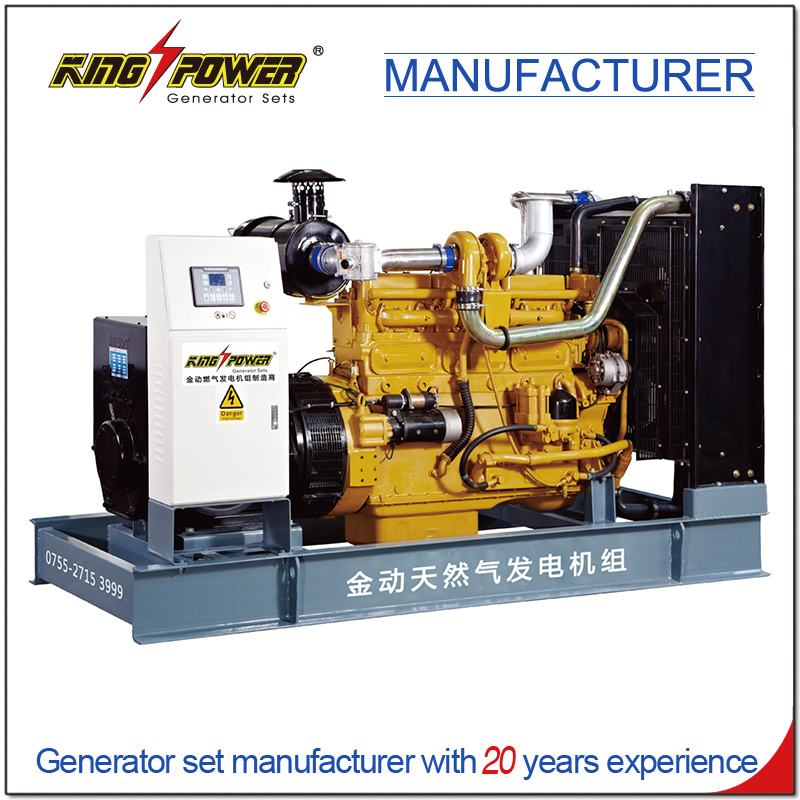
Every deployment faces physical and regulatory boundaries. An industrial sites natural gas generator set often operates under intense scrutiny from local environmental agencies. You must evaluate how the equipment interacts with its immediate surroundings.
Natural gas burns significantly cleaner than diesel. However, local jurisdictions often enforce strict emission caps. The California Air Resources Board (CARB) represents one of the most stringent examples. Compliance often requires specific catalytic converters. You will also need to choose between rich-burn and lean-burn engine configurations. Rich-burn engines allow the use of three-way catalysts to heavily reduce emissions. Lean-burn engines offer higher efficiency but handle emissions differently. Consult your local environmental authority to determine required EPA tier ratings.
Noise pollution dictates enclosure specifications. A standard weather enclosure protects against rain and snow but does little for noise. If you place the unit near residential property lines or healthcare facilities, sound-attenuated enclosures become mandatory. Manufacturers rate these enclosures in decibels (dB(A)) measured at 7 meters. Carefully review your local noise ordinances. Nighttime noise limits often force buyers to upgrade to Level 2 or Level 3 acoustic enclosures.
Extreme climates strain generator cooling systems. You must evaluate ambient temperature ratings based on your exact geography. If you operate in a desert climate, specify high-ambient radiators to prevent overheating. Conversely, sub-zero deployments require heavy-duty engine block heaters and battery warmers. Poor thermal management guarantees failure when you need power the most.
Standard units work well for straightforward backup needs. However, complex facilities require a different approach. You must decide between off-the-shelf equipment and highly engineered configurations. Specifying a custom natural gas generator set provides flexibility for challenging site architectures and unique power demands.
The industry divides solutions into standard product lines and custom builds. Standard lines offer faster lead times and lower upfront costs. Custom solutions address specific engineering bottlenecks. They integrate specialized alternators, advanced control panels, and unique physical dimensions.
Relying on one massive generator introduces a single point of failure. Instead, consider paralleling multiple smaller units. Custom switchgear allows these units to synchronize seamlessly. This approach provides N+1 redundancy. If one engine requires maintenance, the others continue supporting critical loads. Furthermore, paralleling allows for scalability. You can add capacity modularly as your facility load grows over time.
Engines generate tremendous amounts of heat. In standard setups, this thermal energy escapes through the exhaust and radiator. A combined heat and power (CHP) configuration captures this energy. You can redirect it for facility heating, domestic hot water, or absorption chilling. Cogeneration dramatically improves overall fuel utilization metrics. It transforms a standby asset into an active contributor to facility efficiency.
Urban environments rarely offer expansive concrete pads for equipment. Tight footprints require creative engineering. Customization solves spatial constraints.
Buying complex machinery requires a capable partner. Vetting a supplier goes beyond negotiating the lowest unit cost. You are investing in a long-term operational relationship. A cheap unit quickly becomes expensive if it lacks aftermarket support. Evaluate every potential partner using a strict due diligence framework.
First, demand rigorous testing protocols. Never accept a unit without factory acceptance testing (FAT) documentation. You should require certified load bank test results before the unit leaves the factory. This testing proves the engine can handle its rated capacity without overheating.
Second, scrutinize their service network. A supplier's true value ties directly to their Mean Time to Repair (MTTR). Ask about local technician density. Check their inventory for standard parts. Spark plugs, oxygen sensors, and proprietary control modules must be available locally. Waiting weeks for a replacement sensor during storm season is unacceptable.
Read the warranty documentation transparently. Focus entirely on the exclusion clauses. Many warranties become void under easily overlooked conditions. Improper gas pressure can void engine coverage. Lack of certified load bank testing during commissioning often nullifies agreements. Unauthorized modifications or third-party ATS integrations also create contractual loopholes. Clarify these boundaries before signing.
Move beyond marketing brochures. Request detailed technical submittals from the shortlisted candidates. These submittals should include comprehensive sizing calculation reports. They must provide alternator decrement curves to prove short-circuit clearing capabilities. Finally, demand certified sound data sheets mapped to your specific enclosure choice. Hard data separates capable suppliers from mere distributors.
A: Perform a thorough load study aggregating the running wattage of all critical circuits and factoring in the highest starting motor loads (LRA - Locked Rotor Amps). Apply a 20-25% buffer for future expansion and to avoid running the unit at 100% capacity continuously.
A: Theoretically, yes, as long as the municipal gas supply remains uninterrupted and the unit receives required periodic maintenance (e.g., oil changes) based on runtime hour intervals.
A: Rich-burn engines operate with a lower air-to-fuel ratio, allowing the use of 3-way catalysts to heavily reduce emissions (often required in strict non-attainment zones). Lean-burn engines use more air, offering higher fuel efficiency and power density, typically suited for larger continuous applications.

